
Everyone has heard the word “meditation” today. It is used for a breathing exercise in an app, for sitting quietly with your eyes closed, and for centuries-old practices of many traditions. Because of this, a person who has decided to start often gets lost: what should I choose, am I meditating “correctly,” why does it work for others while my head is full of thoughts?
In fact, meditation is not one practice. There are dozens of kinds of meditation, by some estimates more than a hundred, from different traditions, with different names and rituals. But if you look at what a person actually does with their attention, they all fall into just three groups. And these groups differ fundamentally: they engage the brain differently, affect the body differently and suit different people. In this article I explain, as a neurologist and a meditation teacher with more than 25 years of experience, what kinds of meditation exist, what happens in the brain and body during practice, and where you in particular should start.
Send to a friend
Meditation in 2 minutes: the key points
- “Meditation” is not one practice. There are dozens of kinds, but scientists group them into three categories that act on the brain in different ways.
- Meditation is not a belief, a religion or a philosophy but a technical process: calming the nervous system in ways that instruments can measure. You don’t need to change your lifestyle; you simply add meditation to your usual life.
- Concentration means holding attention on one object (qigong, vipassana, focusing on a candle or on the breath). It trains control, and under stress it often tires you more than it restores you.
- Open monitoring means calmly observing your breathing, sensations and thoughts without judging them (mindfulness). It helps you step back from the problem pressing on you right now.
- Automatic self-transcending means the mind settles by itself, without any effort, all the way to inner silence. Most of the research here is on Transcendental Meditation.
- When the mind settles, the body relaxes: breathing slows, oxygen consumption falls and blood flow to the brain improves. Laboratories measured this half a century ago.
- In a study published in The Lancet Psychiatry, meditation helped veterans with PTSD (post-traumatic stress disorder) no less than one of the “gold standards” of psychotherapy.
- Meditation does not replace treatment. But it works with the cause: the tension that builds up in the nervous system over years and shows up as anxiety, insomnia, headaches or high blood pressure.
- Thoughts during meditation are not a mistake but part of the process. The easiest way to understand how to handle them is with a teacher.
- Which group suits you and where to start: in the full article by neurologist Viktor Matsyshyn, MD.
Meditation is a technique, not a belief
Let me start with the most important point, because this is where most misconceptions arise. The meditation discussed in this article is a mechanism of how the nervous system works, a purely technical process. It is not tied to faith, religion or philosophy and does not require any particular worldview. The effect does not depend on whether you believe in it: changes in breathing, in the electrical activity of the brain and in the autonomic nervous system are recorded by instruments within the first minute of practice (Travis & Wallace, Consciousness and Cognition, 1999).
Different meditative practices did indeed arise in different settings. Many of them developed in monasteries and involve seclusion, strict discipline, sessions lasting many hours and a special way of life. For someone who works, raises children and lives at the pace of a big city, such demands are often impossible to meet.
The practices we recommend come from the ancient Vedic tradition. They are authentic techniques adapted to modern life. They require no changes to your lifestyle: you don’t need to change your diet, clothing, beliefs or habits. You live as usual and simply add meditation to your life.
A good comparison is the smartphone. It came into our lives as a phone, and today it holds much more: work, study, keeping in touch with loved ones. We didn’t change our lives because of it; we made them more convenient and richer. In the same way, it is important for people today to build one more technology into their lives: the ability to recover quickly and well. That ability becomes the key to moving forward, reaching goals and feeling satisfied in every area of life.
Meditation is not about belief or about changing your lifestyle. It is a recovery technology that you add to your usual life.
Dozens of meditations, but only three groups
For a long time scientists studied “meditation in general,” mixing completely different techniques in the same studies. As a result, the findings were contradictory. The turning point came when practices began to be distinguished not by name or tradition but by what exactly a person does with their attention.
First, neuroscientist Antoine Lutz and colleagues described two main groups: focused attention meditation and open monitoring meditation (Lutz et al., Trends in Cognitive Sciences, 2008). Later, American neurophysiologist Fred Travis and philosopher Jonathan Shear added a third group, automatic self-transcending, and showed that each group has its own pattern of electrical brain activity (Travis & Shear, Consciousness and Cognition, 2010). A meta-analysis of 78 neuroimaging studies supported a similar approach: practices with a similar procedure activate similar brain areas, while practices from different groups activate different ones (Fox et al., Neuroscience & Biobehavioral Reviews, 2016). Travis later concluded that studying meditations within such groups, rather than “averaging” all practices together, gives the most reliable picture (Travis, Medicina, 2020).
So when someone says “I meditate,” it is worth asking: which group? Zen, qigong, mindfulness and the Technique of Meditation (TM) are not variations of the same thing but different ways of working with the mind.
| Concentration (focused attention) | Open monitoring | Automatic self-transcending | |
|---|---|---|---|
| What attention does | Stays on one object; distraction is constantly noticed and corrected | Observes whatever arises (breathing, sensations, thoughts) without interfering or judging | Naturally moves to quieter levels of thinking, all the way to a state of restful wakefulness without content |
| Effort | High: control, focus | Moderate: maintaining observation | Minimal: the process runs by itself |
| Brain rhythm on the EEG (electroencephalogram) | Beta and gamma rhythms (above 20 Hz) | Theta rhythm (about 4–8 Hz) | Alpha-1 rhythm (8–10 Hz) with high coherence in frontal areas |
| Practices in the group | Qigong; Zen meditation with concentration; vipassana; shamatha; Tibetan Buddhist loving-kindness and compassion meditations; practices of repeating a sound or word and holding attention on it; focusing on a point, a candle flame, an image or the breath | Mindfulness (including MBSR, mindfulness-based stress reduction); zazen; Sahaja Yoga; yoga nidra; observation meditation in the TMR breathing–meditation complex | Transcendental Meditation, the Technique of Meditation (TM); Dzogchen (based on the description of the procedure); some experienced qigong and Zen masters have shown the same pattern |
Table sources: Lutz et al., Trends in Cognitive Sciences, 2008; Travis & Shear, Consciousness and Cognition, 2010; Fox et al., Neuroscience & Biobehavioral Reviews, 2016; Travis, Medicina, 2020.
The boundaries between the groups are not absolutely rigid. Over many years of practice, even demanding concentration can become automatic: experienced Zen and qigong practitioners describe “effortless focus,” and in some masters the alpha pattern typical of the third group has been recorded (Travis, Medicina, 2020). But for most people, especially at the start, the group is defined by the procedure of the practice.
1. Concentration: when meditation becomes one more job
In focused attention practices, a person deliberately holds attention on a chosen object and brings it back each time it “wanders off.” This is control training, and on the EEG (electroencephalogram) it is accompanied by high-frequency gamma activity typical of intense mental work. Gamma rhythm is most often recorded during qigong, Zen meditation, vipassana and compassion meditations, because these practices require focus and control over mental processes (Travis, Medicina, 2020).
As a clinician, I rarely advise people who come with stress, anxiety or exhaustion to start with concentration. Their lives already consist of control, deadlines and constant focus. Adding another half hour of strenuous attention-holding means giving the nervous system one more load rather than rest. This is my practical position, not the result of comparative studies, but it is supported by many stories from students who “gave up meditation” because it tired them out.
2. Open monitoring: a step back from the problem
Here attention is not tied to one object. The person observes what is happening: breathing, sensations in the body, thoughts that come and go, without judging and without trying to change anything. This group is characterized by frontal midline theta rhythm, linked to attention to internal processes (Travis, Medicina, 2020). It includes mindfulness programs, zazen, Sahaja Yoga and yoga nidra.
The best-studied representatives of this group are mindfulness programs. A large meta-analysis of 47 randomized trials showed that they moderately reduce anxiety, depression and pain (Goyal et al., JAMA Internal Medicine, 2014).
The value of open monitoring is that it helps you step back from the problem pressing on you right now. A person learns to see their thoughts and emotions from the outside rather than merging with them.
3. Automatic self-transcending: easily and without effort
The third group is fundamentally different from the first two. There is no holding of attention and no constant observation. Most of the research in this group is on Transcendental Meditation, the practice we teach in the Technique of Meditation (TM) course. Based on the description of its procedure, the Tibetan practice of Dzogchen also belongs here. The practice is designed so that the mind, by its very nature, moves by itself to ever finer, quieter levels of activity and then beyond ordinary thinking, into a state of restful wakefulness (Travis & Shear, Consciousness and Cognition, 2010).
Physiologically, this state has clear signs. Fred Travis spent more than twenty years studying what happens in the brain and body during Transcendental Meditation. Within the first minute of practice, breathing slows, skin conductance falls (a sign of less sympathetic activation), and respiratory sinus arrhythmia and alpha coherence between the frontal and posterior areas of the brain increase (Travis & Wallace, Consciousness and Cognition, 1999). At moments of the deepest settling, breathing can almost stop for a short time without any effort; this is not breath-holding but a natural reduction in the need to breathe (Travis & Wallace, Psychophysiology, 1997). A systematic review of studies of such states across different traditions confirmed the same picture: slower breathing, lower muscle activity, and stronger alpha rhythm and functional connectivity in the brain (Wahbeh et al., Explore, 2018).
A separate study showed that on the EEG (electroencephalogram) the Technique of Meditation (TM) does not resemble concentration practices: instead of high-frequency activity and “switching off” the brain’s default mode network, theta and alpha activity is seen in the areas of that very network (Travis & Parim, Brain and Cognition, 2017). In other words, the brain does not strain but shifts into a mode of calm alertness.
Meditation does not have to be an effort. In the practices that are most effective for recovery, the mind settles by itself, as naturally as we fall asleep when we are tired.
How meditation acts on the body: from mind to cells
Mind and body are closely linked, so changes in one inevitably show up in the other. When mental activity settles during meditation, a whole chain of processes is set in motion.
- The body relaxes and breathing slows. Muscle tone and breathing rate decrease (Wahbeh et al., Explore, 2018).
- Metabolism slows. In a classic study of Transcendental Meditation published in Science, a drop in oxygen consumption and heart rate was recorded during practice (Wallace, Science, 1970). A later review described this state as “wakeful hypometabolism”: the body rests more deeply than in ordinary rest, while awareness stays clear (Jevning et al., Neuroscience & Biobehavioral Reviews, 1992). These papers are old but remain fundamental for understanding the physiology of meditation.
- Blood flow to the brain improves. During the Technique of Meditation (TM), blood flow in the frontal and occipital areas of the brain increased, and cerebral vascular resistance decreased (Jevning et al., Physiology & Behavior, 1996).
- The activity of genes linked to cellular energy changes. In people who regularly practice deep relaxation, the activity of genes for energy metabolism and mitochondrial function (the “power stations” of the cell) increased, and the activity of inflammation genes decreased (Bhasin et al., PLoS One, 2013). These are promising but still preliminary data.
- The cortex takes over regulation. According to the neurovisceral integration model, the prefrontal cortex inhibits automatic anxiety responses and influences the heart through the vagus nerve (Thayer et al., Neuroscience & Biobehavioral Reviews, 2012). The better this “top-down” control works, the more clearly a person recognizes their own states and the less they are driven by unconscious reactions.
The links in this chain have not been studied equally: changes in breathing and EEG (electroencephalogram) are well described, while the effects on microcirculation and cellular metabolism have been studied much less so far. But the overall logic is clear: a calmer mind, a calmer body, and a more economical mode of operation for the whole organism.
A flashlight in a dark basement: why meditate when “everything is fine”
Let me explain an image I use in my classes. It is not a scientific model but a metaphor that helps convey the essence.
Imagine our subconscious as a dark basement. Everything we have lived through is stored there: stressful situations, losses, fears, traumatic events. We cannot see them; our ability to recognize them there is weakened or absent altogether. But what we have lived through does not disappear. It is like seeds that sprout over time, and on the surface we see the “fruit”: headaches, anxiety, low mood, sleep problems, high blood pressure, digestive problems. These symptoms are often hard to control with medication alone, because they are the consequence, not the cause.
During meditation our attention works like a flashlight lighting up this basement. When the nervous system is in a state of deep calm, it gets the chance to gradually “process” what has built up, without reliving the pain.
Meditation does not cure everything. But when the body’s adaptive reserves are depleted, it should be an essential part of recovery alongside all the necessary treatments, because it works with the cause and not only with the consequences.
This is my position as a physician. It is important not to overstate it: if the body is already weakened and persistent symptoms have appeared, full medical care is needed, and meditation does not replace it. At the same time, scientific data support the view that meditative practice can help substantially:
- In a randomized trial of 203 veterans with PTSD (post-traumatic stress disorder), Transcendental Meditation proved no less effective than prolonged exposure therapy, one of the “gold standards” of PTSD treatment; 61% of participants in the meditation group and 42% in the exposure therapy group showed clinically significant improvement (Nidich et al., The Lancet Psychiatry, 2018).
- A meta-analysis of 16 randomized trials of the Technique of Meditation (TM) showed reduced anxiety, with the largest effect in people with the highest initial anxiety (Orme-Johnson & Barnes, Journal of Alternative and Complementary Medicine, 2014). It should be noted that the authors of this meta-analysis are affiliated with organizations that promote this practice.
- A meta-analysis of 22 randomized trials involving more than 3,000 healthy people found that meditation moderately lowers blood pressure, by 1.5 mmHg systolic on average (Kamijima et al., Journal of Human Hypertension, 2026).
- A new meta-analysis of 132 randomized trials among employees confirmed that meditation reduces stress, anxiety and depression and improves sleep, although no effect on HRV (heart rate variability) or cortisol levels was found in these studies (Khanal et al., Health Psychology Review, 2026).
Two courses: TMR and the Technique of Meditation (TM)
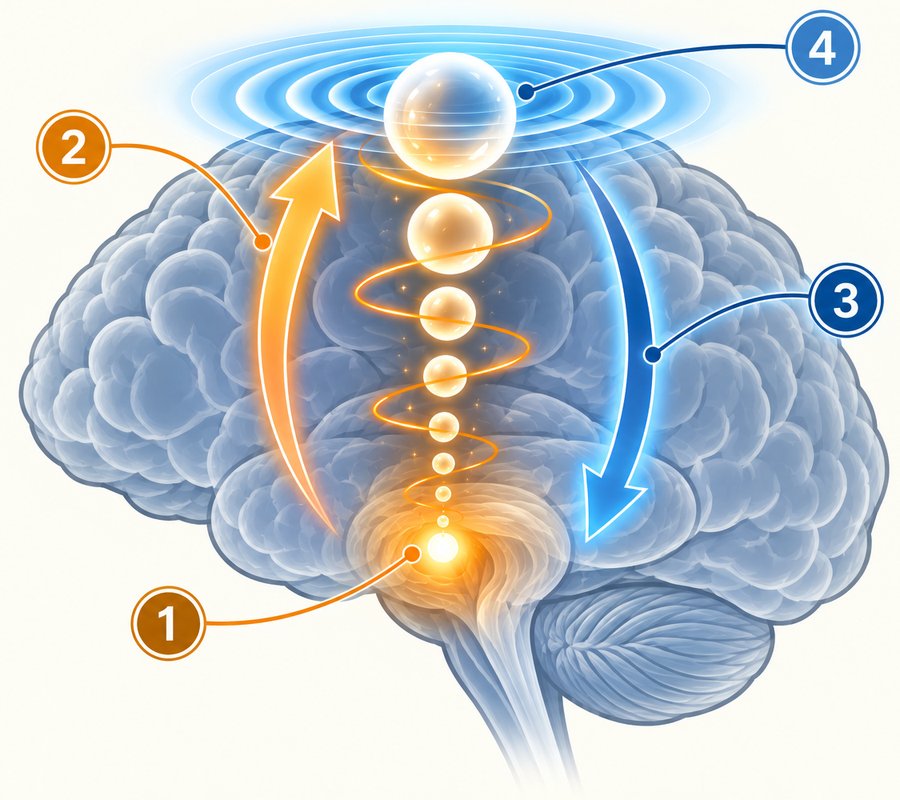
Source of thought: the quietest level of thinking
A thought arises: like a bubble from the depths, it rises to the surface, and we become aware of it as a formed idea
Technique of Meditation (TM): attention moves in the opposite direction, toward the source of thought; the mind settles and the body relaxes
Technique of Mental Relaxation (TMR): observation of spontaneous breathing, which helps keep attention balanced and reduces the impact of stress
The diagram illustrates levels of thinking, not anatomical structures of the brain.
I teach two courses that correspond to two different kinds of meditation: the Technique of Mental Relaxation (TMR), my own breathing–meditation complex, and the Technique of Meditation (TM). They can be taken separately; each is self-sufficient.
TMR: when the problem is already here and you need support
TMR (Technique of Mental Relaxation), a breathing–meditation complex, is a course for those who feel they “need to do something” right now. Each of its elements has its own physiological purpose:
- A physical warm-up brings the body out of a state of stiffness, when you “don’t feel like moving.” Such sluggishness is often a sign of prolonged stress.
- Diaphragmatic breathing switches the nervous system toward predominantly parasympathetic regulation, when the body begins to relax.
- Slow 5–5 breathing (in for 5 seconds, out for 5 seconds) restores adaptive reserves, as if recharging your batteries. A meta-analysis of 223 studies showed that this breathing pace raises vagal HRV (heart rate variability) during practice, right after it and after a course of sessions (Laborde et al., Neuroscience & Biobehavioral Reviews, 2022).
- Observation meditation is an open monitoring meditation. It consolidates the experience: the body recognizes the new, calmer pattern as useful and gradually “writes” it into its settings.
In our study of military personnel with combat experience, 14 days of TMR (Technique of Mental Relaxation) practice were accompanied by improved HRV (heart rate variability) measures and a lower stress index, while in the control group these worsened; the study was not randomized, so we state the conclusions cautiously (Matsyshyn et al., Frontiers in Network Physiology, 2026). And in a study of women who had experienced war-related stress, psycho-emotional state improved with both meditation and CBT (cognitive behavioral therapy), but positive changes in autonomic measures were seen only in the meditation group (Matsyshyn et al., Wiadomości Lekarskie, 2025; a lower-quartile journal).
The Technique of Meditation (TM): when it is time to work with the cause
What has built up in the “basement” needs not only calming but gradual clearing, a kind of drainage. This calls for a different practice: self-transcending.
The need for it usually appears by itself. A person meditates for a while and notices that there are a lot of thoughts, the pleasant sensations of the beginning have changed or disappeared, and it seems the practice has “stopped working.” These are exactly the subjective moments we go through in detail in the Technique of Meditation (TM) course: where thoughts come from, what they mean, how to treat them during practice and how to recognize thoughts that are useful for life.
The course consists of four days of instruction. Before it, I recommend watching the introductory and preparatory lectures and talking with the teacher to clarify your expectations. Over these days you gain both a full intellectual understanding of the mechanics of meditation and your own direct experience. After the course, as a rule, no questions about the practice remain.
Open monitoring helps you cope with what is happening now. Self-transcending helps you free yourself from what has built up before.
Before you start practicing, it helps to record a baseline: the stress, anxiety and depression test takes 3–4 minutes and will show the changes a month later (currently in Ukrainian).
Where to start: a short guide
- If things are hard right now (anxiety, tension, poor sleep, low energy), start with the TMR course (breathing–meditation complex). For quick self-help, try 5–5 breathing.
- If you want a deep, stable practice for years that comes easily and without effort, choose the Technique of Meditation (TM).
- If you already meditate but the practice has “stopped working” or there are too many thoughts in your head, this is a good moment to take the Technique of Meditation (TM) course.
- If you already have your own practice, use the meditation timer: a gentle start, silence and a calm finish without an abrupt signal (in Ukrainian for now).
- If you are not sure, write to us and we will help you choose.
Frequently asked questions about meditation
What is meditation, in simple terms?
Meditation is a technique that teaches attention to move from active thinking to a calmer state. During practice the nervous system switches from tension mode to recovery mode: breathing and pulse slow down, muscle tone falls, and awareness stays clear. It is a skill you can learn, like swimming or driving a car.
How should a beginner start meditating?
The simplest safe start is slow breathing: 5–10 minutes sitting down, breathing in and out for 5 seconds each, twice a day. For a deeper and more stable effect, it is better to learn a technique with a teacher, who will explain how to practice correctly and help you at the start so that meditation does not turn into a fight with your thoughts. Both courses are described on the pages Technique of Meditation (TM) and Technique of Mental Relaxation (TMR).
How much time a day do I need to meditate?
Regularity matters more than duration. In the Technique of Meditation (TM) it is 15–20 minutes twice a day, morning and evening; in the TMR breathing–meditation complex, 15–20 minutes once a day. Short daily sessions give more than an hour once a week.
Do I need to believe in anything for meditation to work?
No. Meditation is a technique for working with attention, and its effects are measured physiologically: by breathing, EEG (electroencephalogram) and heart rate measures. It works regardless of your worldview.
Will I have to change my lifestyle?
No. You don’t need to change your diet, routine, beliefs or habits. Meditation is simply added to your usual schedule, typically as two short sessions a day. Many people later notice on their own that they sleep better, get irritated less and have more energy, but this is a result, not a requirement.
Can I learn to meditate on my own, from an app or videos?
Some simple open monitoring practices, yes. But most people who start on their own soon run into questions: am I doing it right, why are there so many thoughts, why has the effect gone? Without an explanation of the mechanics of the process, people often give up. Learning with a teacher gives you both the correct technique and an understanding of how to work with it.
What should I do if I have a lot of thoughts during meditation?
This is normal and does not mean you are meditating incorrectly. Thoughts are a natural part of the process, and in self-transcending practices they even reflect the nervous system working through accumulated tension. We explain in detail on the course how to treat them.
How long does it take to feel the effect?
Many people notice changes in how they feel within the first days; you can see how from the experience of 104 of our students (in Ukrainian). Lasting changes in sleep, anxiety and energy usually form over several weeks of regular practice. In a meta-analysis of anxiety studies, a substantial reduction was recorded within the first two weeks (Orme-Johnson & Barnes, Journal of Alternative and Complementary Medicine, 2014).
Can I meditate if I am in treatment or taking medication?
Yes, meditation combines with medication and psychotherapy. Do not stop prescribed medication on your own. If you have a serious mental illness, discuss the practice with your treating doctor.
About the author
Viktor Matsyshyn, MD, is a neurologist (highest qualification category), reflexologist and research fellow at the State Institution of Science “Center of Innovative Healthcare Technologies” State Administrative Department (Kyiv, Ukraine). He has been a teacher of Transcendental Meditation since 2000 and is the author of the Technique of Mental Relaxation (TMR) method and of scientific publications on the effects of breathing–meditation practices on the nervous system. More about the author.
References
- Lutz A, Slagter HA, Dunne JD, Davidson RJ. Attention regulation and monitoring in meditation. Trends Cogn Sci. 2008;12(4):163-169. doi:10.1016/j.tics.2008.01.005
- Travis F, Shear J. Focused attention, open monitoring and automatic self-transcending: Categories to organize meditations from Vedic, Buddhist and Chinese traditions. Conscious Cogn. 2010;19(4):1110-1118. doi:10.1016/j.concog.2010.01.007
- Travis F. On the Neurobiology of Meditation: Comparison of Three Organizing Strategies to Investigate Brain Patterns during Meditation Practice. Medicina (Kaunas). 2020;56(12):712. doi:10.3390/medicina56120712
- Fox KCR, Dixon ML, Nijeboer S, et al. Functional neuroanatomy of meditation: A review and meta-analysis of 78 functional neuroimaging investigations. Neurosci Biobehav Rev. 2016;65:208-228. doi:10.1016/j.neubiorev.2016.03.021
- Goyal M, Singh S, Sibinga EM, et al. Meditation programs for psychological stress and well-being: a systematic review and meta-analysis. JAMA Intern Med. 2014;174(3):357-368. doi:10.1001/jamainternmed.2013.13018
- Travis F, Wallace RK. Autonomic and EEG patterns during eyes-closed rest and transcendental meditation (TM) practice: the basis for a neural model of TM practice. Conscious Cogn. 1999;8(3):302-318. doi:10.1006/ccog.1999.0403
- Travis F, Wallace RK. Autonomic patterns during respiratory suspensions: possible markers of Transcendental Consciousness. Psychophysiology. 1997;34(1):39-46. doi:10.1111/j.1469-8986.1997.tb02414.x
- Wahbeh H, Sagher A, Back W, Pundhir P, Travis F. A Systematic Review of Transcendent States Across Meditation and Contemplative Traditions. Explore (NY). 2018;14(1):19-35. doi:10.1016/j.explore.2017.07.007
- Travis F, Parim N. Default mode network activation and Transcendental Meditation practice: Focused Attention or Automatic Self-transcending? Brain Cogn. 2017;111:86-94. doi:10.1016/j.bandc.2016.08.009
- Wallace RK. Physiological effects of transcendental meditation. Science. 1970;167(3926):1751-1754. doi:10.1126/science.167.3926.1751
- Jevning R, Wallace RK, Beidebach M. The physiology of meditation: a review. A wakeful hypometabolic integrated response. Neurosci Biobehav Rev. 1992;16(3):415-424. doi:10.1016/s0149-7634(05)80210-6
- Jevning R, Anand R, Biedebach M, Fernando G. Effects on regional cerebral blood flow of transcendental meditation. Physiol Behav. 1996;59(3):399-402. doi:10.1016/0031-9384(95)02006-3
- Bhasin MK, Dusek JA, Chang BH, et al. Relaxation response induces temporal transcriptome changes in energy metabolism, insulin secretion and inflammatory pathways. PLoS One. 2013;8(5):e62817. doi:10.1371/journal.pone.0062817
- Thayer JF, Åhs F, Fredrikson M, Sollers JJ, Wager TD. A meta-analysis of heart rate variability and neuroimaging studies: implications for heart rate variability as a marker of stress and health. Neurosci Biobehav Rev. 2012;36(2):747-756. doi:10.1016/j.neubiorev.2011.11.009
- Nidich S, Mills PJ, Rainforth M, et al. Non-trauma-focused meditation versus exposure therapy in veterans with post-traumatic stress disorder: a randomised controlled trial. Lancet Psychiatry. 2018;5(12):975-986. doi:10.1016/S2215-0366(18)30384-5
- Orme-Johnson DW, Barnes VA. Effects of the transcendental meditation technique on trait anxiety: a meta-analysis of randomized controlled trials. J Altern Complement Med. 2014;20(5):330-341. doi:10.1089/acm.2013.0204
- Kamijima J, Ikeda A, Charvat H, et al. Effect of interventions for stress management on blood pressure changes in healthy adults: a systematic review and meta-analysis. J Hum Hypertens. 2026. doi:10.1038/s41371-026-01236-4
- Khanal MK, Saunders P, Nguyen K, et al. Meditation and workplace health: a systematic review and meta-analysis of mental and cardiometabolic outcomes among employees. Health Psychol Rev. 2026:1-30. doi:10.1080/17437199.2026.2652892
- Laborde S, Allen MS, Borges U, et al. Effects of voluntary slow breathing on heart rate and heart rate variability: A systematic review and a meta-analysis. Neurosci Biobehav Rev. 2022;138:104711. doi:10.1016/j.neubiorev.2022.104711
- Matsyshyn VS, Kravchenko AM, Ovodiuk NM, Zharkov DY, Apykhtin KO, Romanchuk OP, Chaikovsky IA. Heart Rate Variability, ECG Minor Changes, and HRV–ECG Coupling Associated With an Adjunctive Structured Breathing–Meditation Protocol in Combat-Exposed Military Personnel. Front Netw Physiol. 2026;6:1912231. doi:10.3389/fnetp.2026.1912231
- Matsyshyn VS, Apykhtin KO, Kravchenko AM, Ovodiuk NM, Chaikovsky IA. Peculiarities of psycho-emotional and neurovegetative state in Ukrainian women who have experienced war-related stress and ways of its non-medicinal correction. Wiad Lek. 2025;78(6):1047-1053. doi:10.36740/WLek/207363