
How TMR works: breathing, meditation and the nervous system
Stress is not an event but a mode the nervous system has grown used to living in. The Technique of Mental Relaxation (TMR) helps it learn again to switch between tension and recovery.
Sound familiar?
Your reactions have become sharper, your focus shorter, and weekends no longer restore your energy. This is not weakness and not age. It is a predictable response of the nervous system to prolonged overload, and it can be worked with.
If you recognize even one of these states, TMR can be a good first step.
- Chronic stress or inner tension
- Trouble falling asleep, or sleep that doesn't restore you
- Your mind doesn't "switch off" even at rest
- Irritability and sharp reactions
- Burnout, apathy, lack of energy
- Anxiety or panic attacks: in that case we recommend the individual format
Why a single exercise doesn't help for long
A house is not a pile of bricks but a well-designed structure in which each element supports the others. TMR is the same: well-known, proven techniques give a lasting result only in the right sequence.
An effect that lasts an hour
After an exercise from an app you feel better, but the tension comes back later.
One link out of many
A single technique affects only one of the mechanisms that keep tension going.
Stress is a mode
For it to change, the nervous system needs regular training, not one-off relief.
Why shallow, rapid breathing keeps anxiety going: read the article on how CO₂ (carbon dioxide) levels are linked to anxiety.
Two courses: self-regulation and deep recovery
TMR gives you tools to consciously bring back calm here and now. The Technique of Meditation (TM) gradually changes the background state of the nervous system itself. Each course works on its own, and together they complement each other.
TMR: a breathing–meditation complex
Warm-up, diaphragmatic breathing, slow 5–5 breathing and observation meditation. Control over your state here and now.
- Calming down in 3–5 minutes in an acute situation
- Falling asleep more easily
- Less background anxiety
15–20 minutes once a day
More about TMRTechnique of Meditation (TM)
A silent practice done sitting with eyes closed, without concentration or controlling your thoughts. It gradually changes the background state of the nervous system itself.
- Fewer emotional "explosions"
- A steadier mood and more energy
- Deeper sleep
15–20 minutes twice a day
More about TMEach course is complete in itself: you can start with either one and take them separately.
Three modes of brain function
A healthy brain switches flexibly between three modes, like gears in a car. Under chronic stress it gets "stuck" in focus, and recovery never fully switches on.
Focus
Attention is gathered on a task: a resource for complex actions.
Observation
You notice your reaction before it turns into action.
Recovery
The brain sorts through what you have experienced and restores its resources.
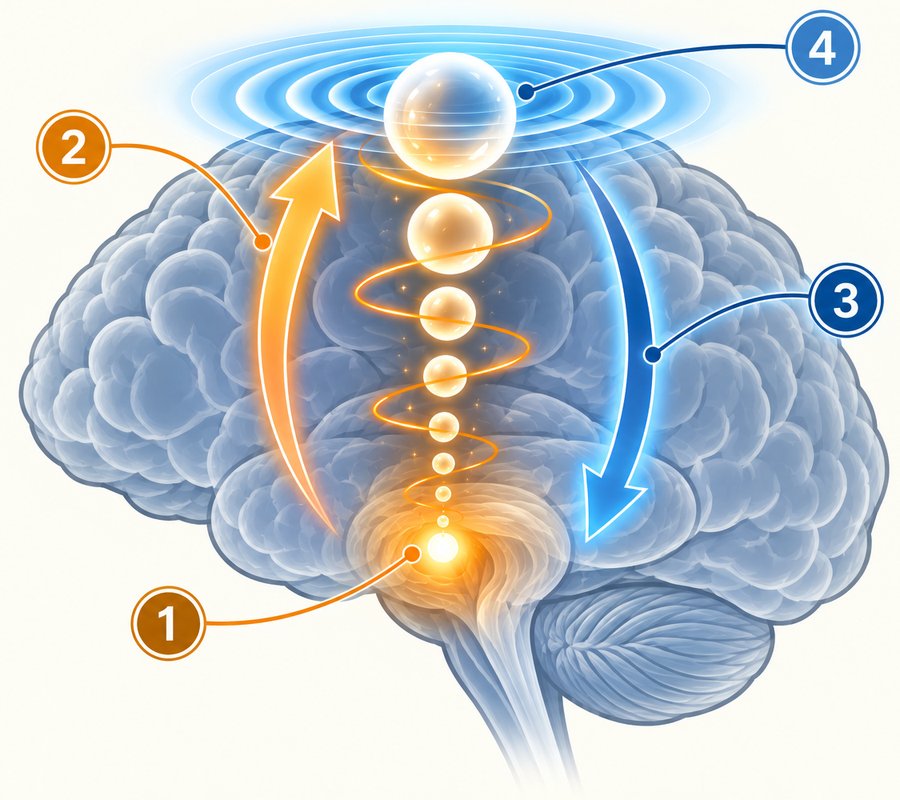
Attention moves from thought to silence
A thought is born in the depths and becomes more and more noticeable as it rises to the surface. During TM, attention naturally moves in the opposite direction, from active thinking to quieter levels, easily and without effort.
The brain enters a state of deep rest while staying clear. You don't have to "stop thinking": the technique works even when your head is full of thoughts.
The diagram illustrates levels of thinking, not anatomical structures of the brain.
What meditation is and how it works →What happens in the body during 20 minutes of practice
It is different for everyone, but the direction of change is the same.
Slows down and evens out; the shallow breathing that accompanies anxiety disappears.
The rhythm responds more flexibly to breathing, and the calming parasympathetic branch switches on.
The body moves more easily from mobilization to recovery.
Several hours of an even background without unnecessary tension.
These changes can be seen objectively in HRV (heart rate variability). In individual sessions in Kyiv we track them with the Harmony device. TMR research →
What to expect, and when
This is not a promise but a summary of typical observations with regular practice. Regularity matters more than duration.
Deep calm and an unexpectedly clear head.
Deeper sleep, easier falling asleep, mornings without heaviness.
Things that used to throw you off balance affect you less.
Calm and an even mood increasingly become your usual state.
The practice becomes a way of maintaining your quality of life.
What people who took the course say
Real changes in people who started with the same difficulties as you. Translated from Ukrainian.
I used to wake up at 4 a.m. and couldn't fall back asleep. After three weeks of TMR I fell asleep and slept until seven for the first time. After two months of TM I noticed I still had energy on Friday; before, I used to crawl to Friday.
My husband said something harsh at dinner, and I didn't explode. I just heard that he was tired. It sounds small, but for me it was the first time in years.
I was skeptical. I went through it myself. Now I sometimes recommend it as a supportive non-pharmacological practice within an overall recovery plan, especially for people with autonomic symptoms.
Where to start
Start with TM
If you want to change the background state of your nervous system itself and are ready to give it 2 × 20 minutes a day. No preparation is needed.
TM courseStart with TMR
If you first need tools to help yourself quickly, with sleep problems or anxiety.
TMR courseTake both
For the best long-term result. The order isn't critical: the courses reinforce each other.
RegisterNot sure? Start with a free practice: "5–5 breathing".
TMR is a non-pharmacological self-regulation method, not a replacement for treatment or psychotherapy. If you have panic attacks, marked anxiety, PTSD (post-traumatic stress disorder), depression, epilepsy, uncontrolled hypertension, or you take psychotropic medication, start with the individual format.
Viktor Matsyshyn is a neurologist with more than 25 years of experience and a research fellow at the State Institution of Science "Center of Innovative Healthcare Technologies" State Administrative Department. The effects of TMR are being studied in scientific research.
Frequently asked questions
I'm not religious / I'm a skeptic. Is this for me?
Yes. TMR works through the physiology of the nervous system: there is no spiritual context, no required beliefs and no symbolism. Skeptics often find it easier to accept the method when they see measurable changes.
How much time does it take a day?
TMR: 15–20 minutes once a day. TM: 15–20 minutes twice a day. Many students notice that the practice doesn't take time away but helps them use it better.
What if I can't "clear my head"?
Nobody can at first. TM deliberately doesn't ask you to "stop thinking": the technique works even when your head is full of thoughts.
I've already tried meditation in an app. Is this the same?
No. Apps offer short practices for relaxing in the moment. TMR is a structured protocol with personal guidance and a way to track changes objectively.
Is it safe with an anxiety disorder, after trauma or with hypertension?
Gentle breathing and meditation practices are often a useful complement to the main care. But if you have a diagnosed condition, start with the individual format. TMR does not replace a doctor's consultation, psychotherapy or treatment.
What happens if I stop practicing?
The changes you have built up don't vanish at once, but without practice the background state can gradually return, especially under constant stress. Most students continue because they feel the difference.
Start with a conversation with a Learning Coordinator
We will answer your questions and help you choose a format. In English, classes are held online via Zoom.
Register for training